4 - Target Radar Cross Section: The Concept of Electromagnetic 'Dimension'

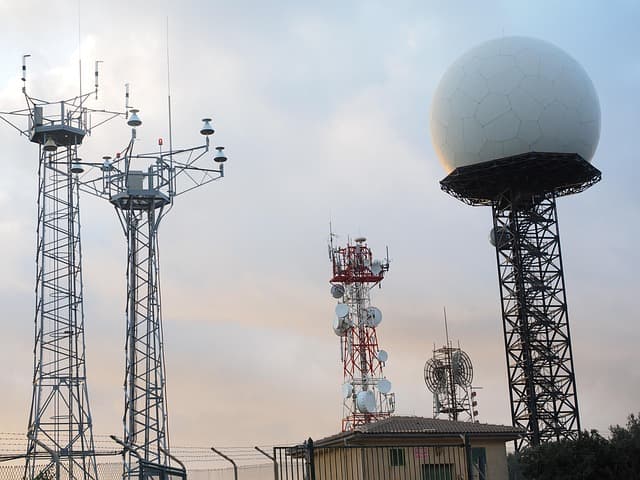
This article is based on the fourth part (Lecture 4 - Target Radar Cross-Section) of the MIT Lincoln Laboratory "Introduction to Radar Systems" lecture series. Radar cross-section (RCS) defines how effectively a target reflects radar waves. Regardless of physical size, it is the target's "visible area" from an electromagnetic perspective.
1. What is Radar Cross-Section?
Radar cross-section (σ or RCS) answers the question: "How much energy does this target return to the radar?"
1.1 Formal Definition
Physicist/engineer definition: Radar cross-section is a hypothetical area that captures the incident power density on the target and re-radiates it isotropically (equally in all directions) — such that the power returned to the radar equals the power returned from the real target.
σ = lim(R→∞) [4πR² × |Es|² / |Ei|²]
Here, Es is the scattered electric field, and Ei is the incident electric field.
1.2 Key Properties
Unit: square meter (m²) — a measure of area
Independent of distance: The R⁴ term is accounted for in the definition
May differ from physical area: A 10 m² physical area may have 0.01 m² RCS (stealth)
Depends on angle, frequency, polarization
2. Factors Determining RCS
2.1 Target Properties
Size: Generally, larger targets have larger RCS, but there are exceptions.
Shape: Flat surfaces have high specular reflection, slanted surfaces have low backscatter.
Material: Metal = high reflectivity; composite/absorbing materials = low RCS.
Orientation: The same target can show 1000-fold different RCS at different angles.
2.2 Radar Parameters
Frequency: The ratio of wavelength to target size is critical — Rayleigh, resonance, optical regions.
Polarization: Vertical vs horizontal polarization can yield different RCS values.
Monostatic vs Bistatic: Is the transmitter-receiver at the same location or at different locations?
3. RCS of a Sphere: Three Regions
Even the simplest target, a sphere, exhibits complex behavior. Three regions are defined according to the ratio of wavelength (λ) to sphere radius (a):
3.1 Rayleigh Region (λ >> a)
When the wavelength is much larger than the target:
σ ∝ a⁶ / λ⁴
RCS increases with the fourth power of frequency
Small particles (rain, fog) are in this region
Meteorological radars' ability to detect rain is based on this principle
3.2 Mie (Resonance) Region (λ ≈ a)
When the wavelength is comparable to the target size:
RCS oscillates strongly with frequency
Interaction of specular reflection and "creeping wave"
Calculations are complex — "danger zone"
Sharp peaks and nulls due to constructive/destructive interference
3.3 Optical Region (λ << a)
When the wavelength is much smaller than the target:
σ ≈ πa² (geometric area)
RCS approaches the physical cross-sectional area
The "normal" behavior as seen by our eyes
Calculations are relatively simple
3.4 Creeping Wave
When an electromagnetic wave strikes a sphere, part of it reflects directly (specular), while another part "creeps" along the surface of the sphere to the back and re-radiates.
Interference between these two components produces the oscillations in the resonance region.
4. Typical RCS Values
Target | Typical RCS (m²) |
|---|---|
Insect | 0.00001 |
Bird | 0.01 |
Human | 1 |
Bicycle | 2 |
Automobile | 10-100 |
Single-engine small aircraft | 1 |
4-person jet | 2 |
Fighter jet | 6 |
Jumbo jet (747) | 100 |
Small boat | 0.02 |
Cabin cruiser | 10 |
5000-ton ship | 10,000 |
5. RCS of Complex Targets
Real targets (aircraft, ships, missiles) are not spheres but complex structures. There are many components contributing to RCS.
5.1 Structural Components
Body shape (nose, cylindrical fuselage)
Wings and control surfaces
Tail and stabilizers
Sharp edges and corners
5.2 Propulsion System Components
Air inlets — cavity effect, very high RCS
Exhaust outlets
Propeller or fan blades
Engine compressor surfaces
5.3 Avionics Components
Radar antennas and radomes
GPS and communication antennas
Altimeter antennas
Seeker openings
6. Scattering Mechanisms
When an electromagnetic wave strikes a target, currents are induced on the surface to satisfy Maxwell's equations. These currents generate the scattered wave.
6.1 Specular Reflection
A wave incident perpendicular to a flat surface reflects back like a mirror. It is the strongest backscattering mechanism.
Example: The fuselage of an aircraft, when viewed from the side, acts as a giant specular reflector — RCS can reach 100 m².
6.2 Edge Diffraction
Sharp edges (wing leading/trailing edges) scatter part of the wave toward the radar.
Leading edge diffraction: When the electric field is along the edge
Trailing edge diffraction: When the electric field is perpendicular to the edge
Depends on polarization: Different polarizations "illuminate" different edges
6.3 Cavity Reflection
Open cavities (engine inlet, cockpit) are extremely strong reflectors:
Energy enters the cavity, reflects off internal walls, and exits back
Standing waves form under resonance conditions
A single cavity can dominate the RCS of the entire aircraft
In stealth design, cavities are concealed with special shaping or absorbing material
7. Angular Dependence: Cone-Sphere Example
A simplified missile model (cone + hemisphere) shows how RCS depends on angle:
Aspect Angle | Typical RCS |
|---|---|
Nose (0°) | 0.001 m² (very small) |
Side specular (~70°) | 100 m² (huge!) |
Tail (180°) | 0.75 m² (hemisphere area) |
Result: The same target can exhibit 100,000-fold different RCS depending on the aspect angle!
8. RCS Measurement
8.1 Full-Scale Measurements
The real target is mounted on a low-RCS support and measured:
Support (pylon): Dielectric material or shaped metal
Background subtraction: Measurement without target → measurement with target → difference = target RCS
Advantage: Real results
Disadvantage: Expensive, time-consuming, weather-dependent
8.2 KCompact Range
Controlled measurement in an enclosed facility:
Parabolic reflector generates a plane wave
Walls are covered with absorbing material (prevents multipath)
Independent of weather conditions
Both full-scale and sub-scale models
8.3 Sub-Scale Models
Measurement is performed using a scaled-down model of the target:
Scaling rule: If the model is reduced by a factor of 1/s, the frequency should be increased by a factor of s.
σ_real = s² × σ_measured
9. RCS Prediction
Measurement is not always possible or practical. Computational methods are used.
9.1 High Frequency Methods
Physical Theory of Diffraction (PTD): Body currents + edge currents are calculated separately.
Advantage: Fast, suitable for complex geometries
Disadvantage: Does not model multiple reflections (wing-body interaction) well
9.2 Method of Moments (MoM)
The target surface is divided into small pieces (facets), Maxwell's equations are solved for each piece.
Advantage: Accurate results, all interactions included
Disadvantage: Computationally intensive (proportional to number of facets²)
Practical limit: Becomes more difficult as the ratio of target size to wavelength increases
9.3 FDTD (Finite Difference Time Domain)
Numerical simulation of Maxwell's equations in the time domain. Can visualize wave propagation and target interaction.
10. Stealth and RCS Reduction
If you do not want to be perceived as a threat, the only thing you can control is your RCS. Radar power, antenna size, distance — you cannot control these.
10.1 RCS Reduction Techniques
Shaping: Making flat surfaces sloped, directing specular reflection away from the radar
Absorbing materials (RAM): Coatings that convert radar energy into heat
Cavity concealment: Placing RAM at engine inlets, complex geometry
Edge alignment: Aligning all edges at the same angle (concentrating RCS in one direction)
What Did We Learn in This Section?
✓ Definition and physical meaning of radar cross section (RCS)
✓ Target and radar parameters that determine RCS
✓ Three regions for a sphere: Rayleigh, Mie (resonance), optical
✓ Creeping wave mechanism
✓ Typical RCS values for targets
✓ Scattering mechanisms in complex targets
✓ Specular reflection, edge diffraction, cavity reflection
✓ Angular dependence of RCS
✓ Measurement methods: full scale, compact range, sub-scale
✓ Prediction methods: PTD, MoM, FDTD
✓ Stealth design principles
Key message: RCS is the target's "electromagnetic fingerprint." It rarely matches physical size, depends on angle/frequency/polarization, and directly affects detection range via the radar equation.
Source: MIT Lincoln Laboratory, "Introduction to Radar Systems Online" - Lecture 4: Target Radar Cross-Section, 2018.