9 - Tracking and Parameter Estimation in Radar Systems

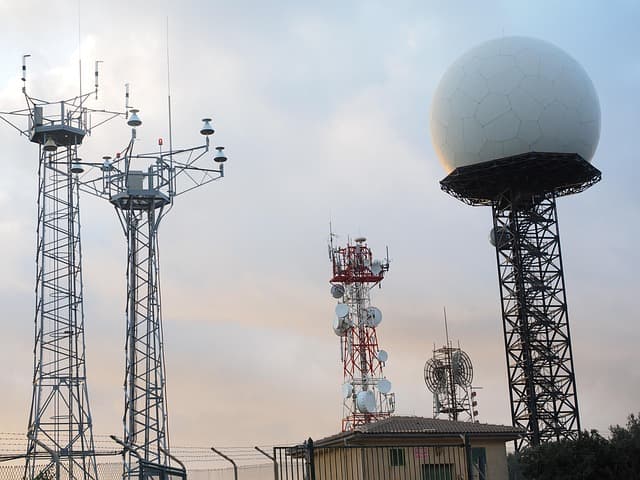
After targets are detected, the radar system has two critical tasks: to make the best estimate of parameters (range, angle, velocity) and to form tracks by associating detections from scan to scan. These processes determine the operational value of the radar—enabling it to say not just "there is something there" but rather "the target is at this location, moving at this speed." In this article, we will examine parameter estimation techniques and tracking algorithms.
Estimated Parameters
Radar systems estimate the following parameters:
Position parameters:
• Azimuth and elevation angle (from antenna pointing direction)
• Range (from echo delay time)
• Radar cross section (in calibrated systems)
Motion parameters:
• Radial velocity (directly from Doppler)
• Radial acceleration (from change in velocity over time)
• Rotation and precession (for rigid bodies)
Parameter Estimation Accuracy
Basic estimation accuracy formulas:
Range accuracy:
σ_R ≈ c/(2B√(2×SNR))
Angle accuracy:
σ_θ ≈ θ_3dB/√(2×SNR)
Doppler velocity accuracy:
σ_v ≈ λ/(2T_coh√(2×SNR))
Here, B is bandwidth, θ_3dB is beamwidth, T_coh is coherent integration time, and SNR is signal-to-noise ratio. All accuracies improve proportionally to the square root of SNR.
Range Estimation
A target typically appears in multiple range samples. The matched filter output forms a peak around the true target position. The location of the largest output provides a coarse estimate, but for better accuracy:
• Curve fitting: least squares fit to the known matched filter response
• Weighted average: mean of sample positions weighted by amplitude
• Interpolation: parabolic interpolation between neighboring samplesWith these techniques, accuracy far beyond the range resolution can be achieved.
Angle Estimation Techniques
Sequential Lobing
The antenna is sequentially pointed in two directions—to the left and right of the target's estimated position. Echo amplitudes received from the two positions are compared. When the target is exactly in the center, the amplitudes are equal; otherwise, the difference indicates the direction toward the target.
Conical Scanning
The antenna beam is rotated around the estimated position of the target. Echo amplitude is modulated by the rotation angle:• Modulation phase → error direction• Modulation amplitude → error magnitudeWhen modulation is zero, the rotation axis is aligned with the target.
Monopulse
Monopulse is the most common and accurate method for angle estimation. Two or more receive beams are formed simultaneously and compared.
Amplitude comparison monopulse:
• Four separate feeds (or array quadrants) are used
• Sum (Σ) and difference (Δ) signals are formed
• Azimuth difference: (A+B) - (C+D)
• Elevation difference: (A+C) - (B+D)
Error signal:
ε = |Δ/Σ| × cos(φ_Δ-Σ)
Here, φ_Δ-Σ is the phase difference between the sum and difference signals. ε linearly indicates how far the target is from the antenna boresight.
Phase comparison monopulse:
• Two separate antennas are used
• The same wavefront reaches both antennas
• Path difference: d×sin(θ)
• Phase difference: 2π×d×sin(θ)/λ
The angle is calculated from the phase difference.
Accuracy, Precision, and Resolution
These three concepts have different meanings:
• Accuracy: Degree to which measurements conform to the true value
• Precision: Repeatability of measurements (low random error)
• Resolution: Ability to distinguish two targets
A system may have high precision (consistent measurements) but low accuracy (systematic error/bias). Resolution is determined by beamwidth, pulse width, and Doppler filter width.
Tracking Algorithms
Tracking is the process of associating successive detections with the same physical object. Basic steps:
1. Detection reports are received
2. Association with existing tracks is attempted (priority)
3. For unassociated detections, a new track is initiated
4. Future position is predicted for updated tracks
5. Tracks without data are "coasted" or terminated
Association is performed using a "search gate" placed around the predicted position.
Gate size:
• Prediction error
• Measurement error
• Possible amount of maneuver
are used to determine it. Detections falling within the gate are track candidates.
Track Filtering
Alpha-Beta tracker:
A simple tracker uses separate gains for position and velocity:
x̂_k = x̂_k|k-1 + α(z_k - x̂_k|k-1)
v̂_k = v̂_k-1 + (β/T)(z_k - x̂_k|k-1)
Kalman filter:
An optimal method calculates dynamic gains by considering the covariances of measurement and process noise. It provides more complex but more accurate estimates, especially for maneuvering targets.
Track-Before-Detect (TBD)
In the conventional approach, a detection threshold is applied first, then tracking is performed. In TBD:
• Data from many scans are stored in memory
• All possible trajectories are tried
• Kinematically meaningful trajectories are sought
• The correct trajectory produces consistent tracks over many scans
Advantages:
• A higher false alarm rate per scan can be tolerated
• Lower SNR targets can be detected
Disadvantages:
• Requires very intensive computation
• There is a delay between detection and notification
Tracking with Phased Array Radars
Phased array antennas provide significant advantages for tracking:
• High update rate (milliseconds)
• Ability to observe many targets simultaneously
• Flexible resource management
Instead of feedback control loops, computer-controlled resource allocation is used. This enables simultaneous execution of surveillance and tracking functions.
Limitations and Errors
Real-world limitations:
• Receiver noise: increases estimation variance
• Calibration errors: create systematic bias
• Target glint: angle noise in complex targets
• Multiple targets: monopulse distortion
• Multipath propagation: bias in low-angle tracking
Angle glint is particularly problematic—phase interference between different scatterers of a complex target can cause the target to appear beyond its physical boundaries.
Conclusion
Parameter estimation and tracking are critical processes that convert the radar's raw detections into usable target information. Monopulse techniques provide angle accuracy well below the beamwidth. Tracking algorithms associate detections from scan to scan and predict target trajectories. Phased array radars offer superior tracking performance thanks to beam agility. Advanced techniques such as TBD enable detection of lower SNR targets at the cost of computational expense. Together, these capabilities determine the tactical value of modern radar systems.