8 - Clutter Suppression in Radar Systems: MTI and Pulse-Doppler Processing

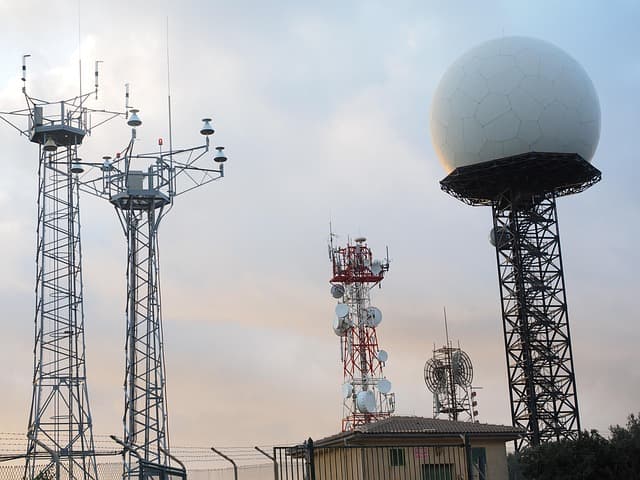
In radar systems, clutter can be tens of thousands to hundreds of thousands of times stronger than target signals. In this case, detection methods based solely on signal amplitude fail. The solution is to use the Doppler effect to distinguish moving targets from stationary or slowly moving clutter. In this article, we will examine Moving Target Indicator (MTI) techniques and Pulse-Doppler processing methods in detail.
Doppler Frequency and Radial Velocity Relationship
Doppler frequency shift is directly related to the target's radial velocity:
f_d = 2v_r/λ
Here, f_d is the Doppler frequency, v_r is the radial velocity, and λ is the wavelength. In the S-band (λ ≈ 10 cm), a radial velocity of 40 m/s corresponds to approximately 1 kHz Doppler shift.
The Doppler-velocity relationship varies significantly across different radar bands:
• VHF (150 MHz): low Doppler sensitivity
• UHF (450 MHz): medium Doppler sensitivity
• S-band (3 GHz): good Doppler sensitivity
• X-band (10 GHz): high Doppler sensitivity
• Ka-band (35 GHz): very high Doppler sensitivity
MTI and Pulse-Doppler: General Comparison
MTI Techniques:
• Separate moving targets from clutter
• Use high-pass filter logic
• Use a small number of pulses (2-3)
• Do not measure velocity
• Simpler implementation
Pulse-Doppler Techniques:
• Separate targets into different velocity regimes
• Perform velocity measurement in addition to clutter suppression
• Use a large number of pulses (10-1000)
• Require a complex filter bank
• Higher performance
MTI Cancellers
The simplest MTI canceller operates by subtracting two consecutive pulses. Since stationary clutter has the same amplitude and phase in both pulses, it is cancelled. Moving targets, on the other hand, have different phases due to Doppler shift and produce a residual signal.
Two-pulse canceller:
y[n] = x[n] - x[n-1]
Three-pulse canceller (wider notch):
y[n] = x[n] - 2x[n-1] + x[n-2]
The MTI improvement factor is defined as the ratio of the output signal-to-clutter ratio to the input signal-to-clutter ratio. Typical values are between 30-50 dB.
Blind Velocities
An important limitation of MTI systems is "blind velocities." When the Doppler frequency is a multiple of the PRF, the target appears to have zero Doppler shift and is cancelled.
Blind velocity:
v_blind = n × λ × PRF / 2
For example, in the S-band (λ = 10 cm) and with a 1 kHz PRF, the first blind velocity is 50 m/s.
Solutions to the blind velocity problem:
• PRF staggering: shifting blind velocities by using different PRFs
• Multiple PRF: moving blind velocities to the least common multiple
Pulse-Doppler Processing
In pulse-Doppler processing, data collected over M pulses is passed through a Doppler filter bank. Each filter passes a specific Doppler velocity range and suppresses the others.
Data collection:
• M pulses are transmitted and echoes are received
• An M × L matrix is formed for each range gate (L: number of range samples)
• Each column (fixed range) is passed through the Doppler filter bank.
Thanks to coherent integration, an M-fold signal gain is achieved when M pulses are used.
Moving Target Detector (MTD)
MTD is a pulse-Doppler system developed at Lincoln Laboratory in the mid-1970s and implemented in FAA airport surveillance radars.
MTD features:
• 8+ Doppler filters for each range-azimuth-Doppler cell
• Clutter map with 300,000 cells
• Adaptive thresholding for each cell
• Processing of 3.5 million cells per scan
• Final processing for rejection of birds and ground traffic
MTD can reliably detect small aircraft (Piper Cherokee) even in heavy rain environments—even when rain backscatter is 30 dB above the noise level.
Range and Doppler Ambiguities
There are two fundamental ambiguities in pulse-Doppler radars:
Range ambiguity:
R_unamb = c × T_R / 2 = c / (2 × PRF)
Doppler ambiguity:
v_unamb = λ × PRF / 2
These two equations reveal a fundamental trade-off: high PRF gives good Doppler ambiguity but poor range ambiguity; low PRF gives the opposite.
PRF regimes:
• Low PRF: Unambiguous in range, very ambiguous in Doppler (ASR radars)
• High PRF: Unambiguous in Doppler, very ambiguous in range (air defense radars)
• Medium PRF: Ambiguous in both (fighter aircraft radars)
Ambiguity Resolution
Doppler ambiguity can be resolved by using multiple CPIs with different PRFs. With two PRFs:
1. The target is detected at both PRFs
2. The apparent Doppler filters are recorded
3. The true Doppler velocity is determined as the only value consistent with both measurements
For more complex cases, the Chinese Remainder Theorem is used. This mathematical method uniquely determines the true range or velocity from multiple PRF measurements.
Sensitivity Time Control (STC)
Due to the R⁴ dependence, radar is much more sensitive at close ranges. STC compensates for this effect by increasing receiver gain over time:
Gain(t) ∝ R⁴(t)
However, STC can only be used with radars that have no range ambiguity (low PRF). In ambiguous range, STC cannot be applied because distant and close targets fall into the same time gate.
Airborne Radar Clutter
Airborne radars encounter a much more complex clutter environment than ground-based radars:
• Platform motion: ground clutter acquires Doppler shift
• Main beam clutter Doppler depends on scan direction
• Sidelobe clutter spreads over a wide Doppler range
• Target Doppler depends on both target velocity and radar platform velocity
One solution is the Displaced Phase Center Antenna (DPCA) technique—different sections of the phase array are activated to compensate for platform motion.
Conclusion
MTI and pulse-Doppler processing are fundamental techniques for detecting moving targets in clutter environments. MTI is simple and effective but is sensitive to blind velocities and does not measure velocity. Pulse-Doppler processing provides comprehensive velocity measurement and optimal clutter suppression but requires more complex hardware and processing. Range and Doppler ambiguities create fundamental trade-offs in PRF selection and are managed with multiple PRF techniques. These techniques are the fundamental building blocks that enable modern radar systems to operate reliably in cluttered environments.