7 - Radar Clutter: Sources, Characteristics, and Effects

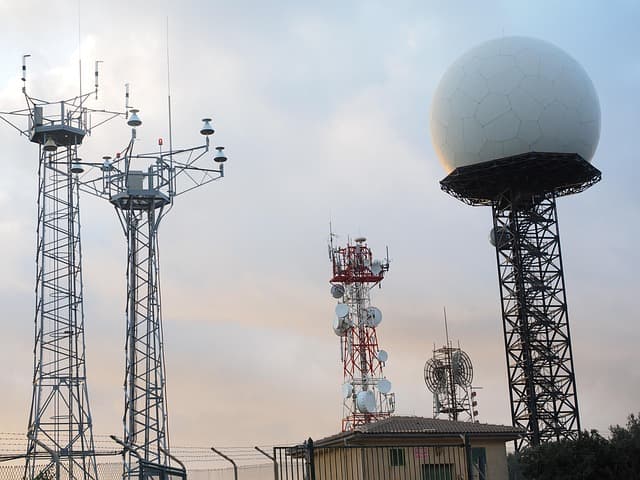
Radar systems receive backscattering not only from target echoes but also from various objects in the environment. All these unwanted backscatterings from sources other than the targets of interest are called "radar clutter." Clutter can seriously affect radar performance and make target detection more difficult. In this article, we will examine in detail the sources of clutter such as ground, sea, rain clutter, as well as chaff and birds.
Why Is Clutter Important?
When the first radars were built, engineers discovered that they were affected not only by targets, but also by:
• Atmospheric noise
• Interference from nearby radars
• Enemy jammers
• And most importantly, backscattering from physical objects.
These unwanted backscattering sources are: ground, sea, rain, chaff, birds, and ground traffic. Especially in the case of modern stealth targets (with low radar cross-section), the clutter problem becomes even more critical.
Ground Clutter
There are two basic facts about ground clutter: it is very large and relatively stationary (but not completely motionless).
Ground backscattering can be tens of thousands to hundreds of thousands of times larger than the radar cross-section of an aircraft. Therefore, other principles such as Doppler processing must be used to detect aircraft in a relatively stationary backscattering environment.
Ground clutter variables:
• Radar frequency
• Spatial resolution (range and azimuth cell size)
• Geometry (grazing angle, radar location)
• Terrain type (flat terrain, mountainous, urban, forest)
The backscattering coefficient σ⁰ (radar cross-section per unit area) characterizes it, and typical values range from -20 dB to -40 dB.
Doppler characteristics of ground clutter:
• Trees sway in the wind → several knots Doppler spread
• Antenna mechanical scanning → 10-12 knots additional spread
• Ship or aircraft-based radar → Doppler shift equal to platform speed
Sea Clutter
Sea clutter is significantly different from ground clutter. The good news: it is about 100 times less intense. The bad news: oceans move – waves can move at speeds of 10-30 knots.
Variables:
• Wind and weather conditions (characterized by sea state)
• Radar frequency and polarization
• Grazing angle
At low grazing angles (<30°), vertical polarization produces 10-20 dB more clutter than horizontal polarization. Therefore, horizontal polarization is generally preferred in marine radars.
Sea spikes: At low grazing angles, sudden and intense backscattering peaks lasting 1-3 seconds may occur. These are probably caused by coherent reflections from wave crests and can cause false alarms.
Rain Clutter
Rain is a type of volumetric clutter and both attenuates and reflects radar signals. Raindrops scatter the signal, so the energy passing through the rain cloud decreases, while backscattering to the radar also occurs.
Rain reflectivity is proportional to f⁴ – that is, it increases dramatically as the wavelength shortens:
• L-band (23 cm): minimal effect
• S-band (10 cm): measurable effect
• X-band (3 cm): significant effect
• Ka-band (8 mm): very severe effect
Rain clutter increases by about 100 times when moving from X-band to Ka-band.
Rain Doppler spectrum:
• Mean velocity: depends on wind speed (varies with direction)
• Spread: typically 6 knots (3 dB width)
• Non-Gaussian, sometimes bimodal distribution
• "Folded" spectrum due to PRF aliasing
Chaff
Chaff is a countermeasure developed during World War II, consisting of half-wavelength dipole elements tuned to radar frequency. It is made of metallic or metal-coated lightweight materials.
Chaff characteristics:
• Resonant metallic dipole cross-section: 0.18λ² m²
• Aluminum foil dipoles: total cross-section ≈ 3000 × (weight lb / frequency GHz)
• Fall speed: 0.5-3 m/s (remains suspended in the air for a long time)
• Bandwidth: 10-15%
Purposes of use:
• Masking: creating a wide area to hide aircraft or missiles
• Deception: small chaff packets that mimic the target
• Diverting tracking radars from the target
Birds and Insects
Birds can be a significant source of clutter, especially during migration periods. Facts:
• 63 passenger pigeon roosts in the Mississippi Valley – each with 1 million birds
• Birds fly 30 miles a day to feed
• During migration, bird density per square mile is 1-1000
Radar cross-sections are individually small, but:
• Large numbers of birds are present in the coverage area
• Some birds' cross-sections can reach levels similar to aircraft
• Resonance effects are observed in S and L bands
• Their speeds are measurable (generally <60 knots)
Insects have even smaller cross-sections, but when present in swarms, they can create more intense clutter than birds. Insect cross-sections can be modeled by their size, similar to water droplets.
Clutter Measurement and Characterization
Lincoln Laboratory conducted a comprehensive ground clutter measurement program in the 1980s:
• 42 sites (USA and Canada)
• Multiple frequencies from VHF to X-band
• Different terrain types: plain, desert, forest, mountainous, urban
These data were analyzed to determine σ⁰ values depending on frequency, polarization, grazing angle, and terrain type. Typical σ⁰F⁴ values for rural sites:
• VHF/UHF: -25 to -35 dB
• L/S-band: -20 to -30 dB
• X-band: -15 to -25 dB
Conclusion
Radar clutter is unwanted backscattering from various sources and can seriously hinder target detection. Ground clutter is large and relatively stationary; sea clutter is weaker but mobile; rain clutter is volumetric and strongly frequency-dependent; chaff is a man-made countermeasure; birds and insects can cause significant problems during migration periods. Understanding the characteristics of clutter forms the basis for developing the next step: clutter suppression techniques (Doppler processing, MTI, pulse-Doppler).