10 - Radar Transmitters and Receivers: Architecture and Technologies

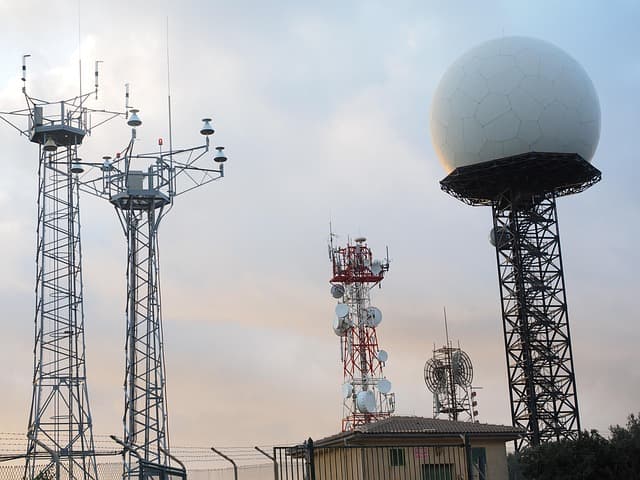
The radar transmitter and receiver are the energy generation and sensing core of the system. The transmitter amplifies the low-power waveform by up to millions of times; the receiver detects and processes echoes at the microwatt level. In this article, we will examine transmitter-receiver technologies, from high-power amplifiers to waveform generators, from duplexers to different system architectures.
General Structure of the Transmitter-Receiver
Simplified block diagram:
Transmitter chain:
Waveform generator → Up-conversion → Amplification → Duplexer → Antenna
Receiver chain: Antenna → Duplexer → Filtering → Amplification → Down-conversion → A/D converter
Power levels change dramatically:
• Waveform generator: mV level
• Transmitter output: kW - MW
• Received echo: µW - mW
• Total dynamic range: ~90 dB
Transmitter-Receiver in the Radar Equation
SNR = (P_avg × G² × λ² × σ) / ((4π)³ × R⁴ × k × T_s × L × B)
Transmitter-receiver components:
• P_avg (average power): higher = better
• T_s (system noise temperature): lower = better
• L (losses): lower = better
Optimization of these parameters is the main goal of transmitter-receiver design.
High Power Amplifiers
Amplification is usually done in stages:
1. Driver amplifiers: watt level
2. Intermediate stages: hundreds of watts
3. Final stage (HPA): kilowatt - megawatt
Two basic topologies:
• Series: stages connected sequentially (single path)
• Parallel: multiple HPAs combined (more power, more complex)
Vacuum Tube Amplifiers
Type examples:
• Klystron: very high power (MW), narrow band
• Traveling wave tube (TWT): wide band, medium power (hundreds of kW)
• Crossed-field amplifier: compact, high efficiency
Characteristics:
• Very high peak power (MW)
• Low duty cycle (1-10%)
• High cost per unit ($300-500K)
• Large physical size
• Low cost per watt ($1-3)
Example: Millstone Radar
• 2 klystrons, L-band (1.3 GHz)
• 3 MW peak power, 120 kW average power
• Tube: 7 ft height, 600 lb weight, $400K cost
• 84 ft diameter parabolic antenna, 42 dB gain
Solid State Amplifiers
Characteristics:
• Low peak power (10-1000 W per module)
• High duty cycle (20-100%)
• Low cost per unit ($100-1000)
• Small physical size
• High cost per watt (in active arrays $50-100)
Example: PAVE PAWS
• 1792 active T/R modules
• 340 W peak power/module
• 75 ft diameter phased array
• >150,000 hours MTBF
Duplexer
The duplexer is a switch that provides critical isolation between the transmitter and receiver. Requirements:
• When transmitting: antenna connected to transmitter, receiver protected
• During reception: antenna connected to receiver, transmitter disconnected
• Isolation: ~90 dB (from MW to µW)
Additional limiter circuits are used for receiver protection - if a strong signal leaks into the receiver, the limiter cuts it to safe levels.
Waveform Generator and Frequency Conversion
The waveform generator creates the modulated signal transmitted by the radar. Generation at low frequency
(<100 MHz):
• More stable
• Cheaper
• Better control
Then, it is shifted to microwave frequency by up-conversion:
f_out = f_LO + f_IF (up-conversion)
f_IF = f_RF - f_LO (down-conversion)
Here, LO is local oscillator, IF is intermediate frequency, and RF is radio frequency.
Advantages of down-conversion:
• A/D converters offer better dynamic range at low frequency
• Digital processing is easier
• Lower cost
System Architectures
Dish Radar
Structure:
• Central transmitter (usually tube)
• Central receiver
• Connection to antenna via waveguide
• Mechanical scanning
Advantages:
• Lowest cost
• Simple design
• Easy frequency change
Disadvantages:
• Focused on a single target
• Slow scanning
• High waveguide losses
• Special transmitter required
Passive Phased Array
Structure:
• Central transmitter
• Ferrite phase shifters at each element
• Corporate feed network
Advantages:
• Beam agility (at µs level)
• Flexible resource management
Disadvantages:
• Feed network losses
• High power phase shifters required
• Higher cost than dish radar
Active Phased Array (AESA)
Structure:
• T/R module at each element
• Solid state amplifiers
• Distributed transmitter and receiver
Advantages:
• Low loss (amplifier at antenna)
• High reliability (graceful degradation)
• Beam agility and resource management
Disadvantages:
• Highest cost
• Complex cooling system
• Long design time
Digital Array
Advanced structure:
• In digital reception: A/D at each element
• In digital transmitter and receiver: waveform generation in T/R module
Advantages:
• Multiple simultaneous beamforming
• Full adaptive processing capability
• Maximum flexibility
Disadvantages:
• Highest computational requirement
• Highest complexity
• Emerging technology
Active T/R Module Structure
A typical T/R module:
• Low power input (from waveform generator)
• Driver amplifier
• High power amplifier (10-100W solid state)
• T/R switch (duplexer)
• Low noise amplifier (LNA)
• Phase shifter
• Control electronics
All these components are integrated into a small module (a few inches) and are supplied with cooling, power, and control lines.
Conclusion
Radar transmitters and receivers are critical subsystems that directly determine performance. Vacuum tube amplifiers provide very high power but are large, expensive, and have low duty cycles. Solid state amplifiers are compact and reliable but have high unit power cost. The duplexer must provide isolation between millions of watts and microwatts. Frequency conversion offers advantages of waveform generation and processing at low frequency. The choice of architecture—dish, passive array, active array, or digital array—involves fundamental trade-offs between cost, performance, and flexibility. Active and digital arrays stand out as the technologies of the future, but for certain applications, dish and passive arrays continue to be cost-effective solutions.