2 - Radar Equation: The Mathematics at the Heart of the System

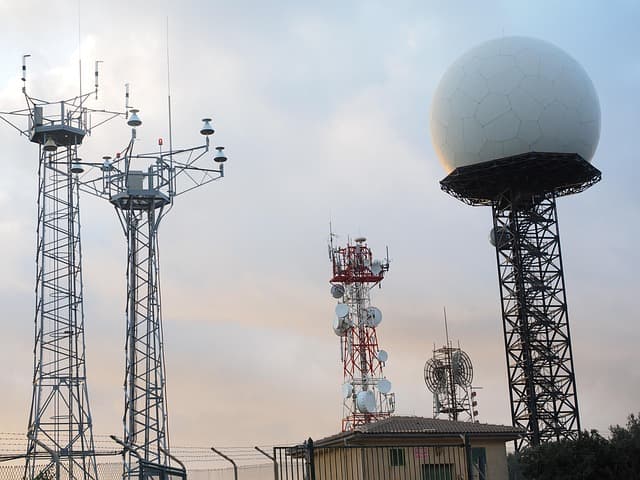
This article is based on the second part (Lecture 2 - The Radar Equation) of the MIT Lincoln Laboratory "Introduction to Radar Systems" lecture series. The radar equation mathematically brings together all the factors that determine the detection capability of a radar system. This equation is the cornerstone of radar engineering and is used at every stage from system design to performance analysis.
1. Why Is the Radar Equation Important?
When designing a radar system or evaluating an existing one, you need to answer the following questions:
How far can this radar detect targets?
How small targets can it detect at a given range?
If I double the transmitter power, how much does the range increase?
How is performance affected if I halve the antenna size?
The radar equation provides answers to all these questions within a single mathematical framework. It links target properties, radar characteristics, distance, and environmental conditions.
2. Derivation of the Radar Equation
Deriving the radar equation from basic physical principles is important for both understanding the equation and grasping its limitations. For this derivation, only algebra and physical intuition are sufficient.
2.1 Step 1: Isotropic Propagation
Let us start with the simplest case: the transmitter radiates energy equally in all directions (isotropic).
Power density at distance R:
Power Density = Pt / (4πR²)
Here, Pt is the transmitter power, and 4πR² is the surface area of a sphere with radius R. Since the energy spreads spherically, power density decreases in proportion to R² as distance increases.
2.2 Step 2: Antenna Gain
Real radars focus energy not in all directions, but in a specific direction. This focusing is expressed by antenna gain (G).
Power density at distance R from a directional antenna:
Power Density = (Pt × Gt) / (4πR²)
Gt is the gain of the transmitting antenna. Gain indicates how much more power density is provided compared to an isotropic antenna.
2.3 Step 3: Target Radar Cross Section
The energy reaching the target is reflected in proportion to the target's radar cross section (σ). The radar cross section represents the electromagnetic "size" of the target.
Power reflected from the target:
Preflected = [(Pt × Gt) / (4πR²)] × σ
2.4 Step 4: Return Propagation
The reflected energy spreads spherically again as it returns from the target to the radar. Therefore, another 1/R² factor is added.
Power density at the radar antenna:
Power Density (radar) = [(Pt × Gt × σ)] / [(4π)² × R⁴]
Critical observation: Power density now decreases in proportion to R⁴ — R² for the outgoing path, R² for the return path.
2.5 Step 5: Receiving Antenna
The receiving antenna collects energy in proportion to its effective area (Ae):
Pr = [(Pt × Gt × σ × Ae)] / [(4π)² × R⁴]
When the same antenna is used for both transmission and reception, since Ae = (Gt × λ²) / (4π):
Pr = [(Pt × G² × λ² × σ)] / [(4π)³ × R⁴]
3. Noise and Signal-to-Noise Ratio
The radar receiver picks up not only the target echo but also noise. Detection capability depends on how strong the signal is relative to the noise.
3.1 Sources of Noise
Galactic Noise: Microwave radiation from space
Solar Noise: Electromagnetic emissions from the sun
Atmospheric Noise: Lightning and other atmospheric events
Man-made Noise: Other radars, radio stations, power lines
Thermal Noise: Noise caused by the receiver electronics' own heat
Intentional Jamming: Jamming signals emitted by the enemy
3.2 Noise Power Formula
All noise sources are represented by an equivalent system temperature (Ts):
Pn = k × Ts × Bn
Here:
k = Boltzmann constant (1.38 × 10⁻²³ J/K)
Ts = System noise temperature (Kelvin)
Bn = Receiver bandwidth (Hz)
3.3 Signal-to-Noise Ratio (SNR)
The signal-to-noise ratio is the fundamental measure of radar detection capability:
SNR = Pr / Pn = [(Pt × G² × λ² × σ)] / [(4π)³ × R⁴ × k × Ts × Bn × L]
L represents all losses in the system (to be detailed later).
Typical expression: "This radar provides 13 dB SNR for a 1 m² target at 1000 km range." This sentence summarizes the radar's detection capability.
4. Surveillance and Tracking Radar Equations
The equation we have derived so far assumes the antenna is looking directly at the target. However, in real operations there are two different scenarios:
4.1 Surveillance (Search) Equation
When the target's location is unknown, the radar must scan a certain angular area. In this case, the equation takes the following form:
Pav × Ae = [(4π × k × Ts × L × Ω × R⁴)] / [(σ × ts × SNR)]
Here:
Pav = Average power
Ae = Antenna effective area
Ω = Scanned solid angle (steradian)
ts = Scan time
Important observation: In the surveillance equation, wavelength (λ) does not appear — power requirement is independent of frequency.
4.2 Tracking (Track) Equation
After the target is detected, tracking is performed to update position and velocity information. In this case, the standard radar equation (with wavelength) applies.
Design process: When designing a radar, first use the surveillance equation to size the system, then use the tracking equation to verify performance.
5. The Dramatic Effect of the R⁴ Law
The most striking feature of the radar equation is that the received power decreases with the fourth power of distance. This creates major challenges in design.
5.1 The Problem of Doubling Range
Question: What must be done to increase the range of a radar with a 1000 km range to 2000 km?
Doubling the range = 16-fold increase in R⁴ = 12 dB loss
To compensate for this loss, you can do one of the following:
Option | Required Change |
|---|---|
Increase transmitter power | 16 times (12 dB) |
Increase antenna diameter | 4 times (antenna area 16 times) |
Increase scan time | 16 times |
Reduce scan area | Reduce by 16 times |
Combined solution | Partial contribution from each |
Comparison: All other parameters (target cross section, scan area, duration) have a linear relationship. To see a target half the size, it is sufficient to double the power. However, doubling the range requires 16 times the power.
6. Real World Radars: Five Examples
To see how the radar equation is applied in practice, let us examine five different radar systems used for civil purposes in the United States.
6.1 Airport Surveillance Radar (ASR-9)
Location: All major airports
Mission: Detecting and tracking aircraft within the terminal area (50-60 miles)
Specifications:
Average power: ~1 kW
Peak power: ~1 MW
Frequency: S-band (2800 MHz, ~10 cm)
Antenna diameter: ~2 meters equivalent
Rotation speed: 12.8 RPM (~360° in 5 seconds)
Note: These radars operate in conjunction with the beacon transponder system. While the radar (primary) detects the target, the beacon system receives the aircraft's identification and altitude information.
6.2 Surface Movement Radar (ASDE)Location: At the top of the air traffic control tower
Function: Monitoring aircraft and vehicle movements on the runway and apron area
Features:
Frequency: Ku-band (~16.5 GHz, ~2 cm)
Range: ~7 km (runway length)
Resolution: Very high
Power: Low (short range)
Rotation: 60 RPM
6.3 Air Route Surveillance Radar (ARSR)
Location: Coastal regions and strategic points
Function: Long-range air traffic surveillance (~200 miles)
Features:
High average power
Large antenna size
Joint civil (FAA) and military (USAF) use
Tracking of aircraft arriving from abroad
6.4 Meteorological Radar (NEXRAD / WSR-88D)
Location: Extensive network throughout the country
Function: Weather monitoring, precipitation and storm detection
Features:
Frequency: S-band (good for observing precipitation)
High average power
Large parabolic antenna
Doppler capability (wind speed measurement)
Slow and precise scanning
Thanks to Doppler processing, the radial velocity of rain clouds is measured. Advanced algorithms can make predictions such as tornado warnings and tornado detection.
6.5 Terminal Doppler Weather Radar (TDWR)
Location: Airports with high wind shear risk
Function: Microburst (sudden downdraft) detection
Critical safety function: Microburst is extremely dangerous during landing/takeoff. The pilot pushes the aircraft down to counteract the initial upward wind; then, when the wind direction reverses, the aircraft is rapidly pushed to the ground. Before TDWR, this phenomenon caused many fatal accidents.
7. Radar Losses: "The Humanity of the System"
The radar equation defines an ideal system. In the real world, energy is lost at every stage. These losses are the factors that radar engineers call "the humanity of the system."
7.1 Transmission Chain Losses
Waveguide Loss: Energy is converted to heat as it is transferred from the transmitter to the antenna.
Radome Loss: The protective cover attenuates the signal.
Rotary Joint Loss: Loss at the connection point for rotating antennas.
Filter Losses: Frequency shaping filters.
Beam Pointing Loss: If the target is not at the exact beam center.
Atmospheric Attenuation: Especially significant at high frequencies.
7.2 Reception Chain Losses
Most transmission losses also apply during reception. In addition:
A/D Quantization Loss: Sensitivity loss during analog-to-digital conversion.
Threshold Losses: CFAR and other adaptive threshold systems.
Range/Doppler Straddling: When the target falls between two cells.
Integration Loss: Non-coherent integration is not ideal.
7.3 Field Degradation
A radar that works perfectly in the laboratory loses performance in the field over time:
Transmitter power decreases
Moisture seeps into the waveguide
Receiver noise figure increases
Components age
Cables loosen or corrode
Practical rule: It is reasonable to allow a 3 dB field degradation margin in the design.
7.4 Typical Loss Values
Type of Loss | Typical Value |
|---|---|
Beam shape loss (mechanical scanning) | 2-4 dB |
Plumbing losses | 2-3 dB |
Signal processing losses | 1-2 dB |
Field degradation | 2-3 dB |
Total losses | 5-15 dB (10 dB typical) |
Warning: If each of the 20-25 separate loss parameters deviates by 0.1-0.2 dB, the total error reaches 5 dB. This reduces the range by 30%!
8. Example Calculation: ASR-9 Radar
Problem: Verify whether the ASR-9 airport surveillance radar can detect a small aircraft (1 m² RCS) at a distance of 60 nautical miles.
8.1 Radar Parameters
Parameter | Value |
|---|---|
Peak power | 1.4 MW |
Duty cycle | 0.5 × 10⁻³ |
Pulse width | 0.6 μs |
Frequency | 2800 MHz (λ ≈ 10 cm) |
Antenna size | 4.9 m × 2.7 m |
Antenna gain | 33 dB |
Rotation speed | 12.8 RPM |
System temperature | 950 K |
Total losses | 8 dB |
8.2 Calculation Steps
Step 1 - Unit Conversions:
Range: 60 nautical miles = 111 km = 1.11 × 10⁵ m
Wavelength: c/f = 3×10⁸ / 2.8×10⁹ ≈ 0.103 m
Gain (linear): 10^(33/10) = 2000
Step 2 - Single Pulse SNR:
When the radar equation is applied:
SNR (single pulse) = 1.35 ≈ 1.3 dB
Step 3 - Coherent Integration:
Number of pulses on target: ~21 pulses
Integration gain = 10 × log₁₀(21) = 13.2 dB
Step 4 - Total SNR:
SNR (total) = 1.3 dB + 13.2 dB = 14.5 dB
Result: 14.5 dB SNR is above the 13 dB threshold. The radar can reliably detect the target.
9. Detection Process: The Big Picture
The radar equation gives the average SNR. However, both noise and target signal are random variables — they fluctuate.
9.1 Noise Statistics
Noise generally has a Gaussian distribution. It fluctuates randomly around the mean value. Sometimes it takes values much higher or much lower than the mean.
9.2 Target Fluctuation
Complex targets (aircraft, ships) do not have a constant RCS:
Reflections from different parts are summed coherently
Small angle changes cause constructive/destructive interference
Even vibrations can change the RCS
Only a sphere has a constant RCS
9.3 Threshold Decision and Probabilities
Detection is made by a threshold comparison. Two probabilities are defined:
Probability of Detection (Pd): Probability of detecting the actual target.
Probability of False Alarm (Pfa): Probability of noise being perceived as a target.
In the ideal case, if the signal and noise distributions were completely separate, we could set a clear threshold in between. In reality, the distributions overlap and a trade-off is required.
10. Radar Equation in the Design Process
10.1 Steve Weiner's Saying
"The radar equation is simple enough for everyone to learn to use, but complex enough for everyone to make mistakes if not careful."
10.2 Practical Recommendations
Unit consistency: All units should be in MKS (meter, kilogram, second). Do not mix kilometers and meters.
Use a template: Create an Excel table, verify units, check formulas, fabitleyin.
Sanity check: Is the result reasonable? Compare it with a known radar.
dB vs natural unit: Do not confuse them in calculations. Multiplication in dB = addition, division = subtraction.
Hidden constraints: Cost, size, weight, technology limits — factors outside the equation.
10.3 Trade-off Example
There may be multiple ways to achieve the same performance:
Larger antenna + less power
Longer scan time + smaller system
Higher frequency + more compact design (but atmospheric loss increases)
Real constraints: For aircraft radar, antenna diameter is limited (nose cone size). For portable radar, weight is limited. Budget is always limited.
What Did We Learn in This Section?
✓ Derivation of the radar equation from physical principles
✓ The dramatic effect of the R⁴ law on performance
✓ Differences between surveillance and tracking equations
✓ Noise sources and the concept of signal-to-noise ratio
✓ Comparative analysis of five different civil radar systems
✓ Sources and typical values of system losses
✓ Practical calculation example (ASR-9)
✓ The probabilistic nature of the detection process
✓ Use of the radar equation in the design process
Summary formula:
SNR = (Pt × G² × λ² × σ) / [(4π)³ × R⁴ × k × Ts × Bn × L]
This equation is the DNA of radar engineering. Every design decision, every performance evaluation is based on a version of this equation.
Source: MIT Lincoln Laboratory, "Introduction to Radar Systems Online" - Lecture 2: The Radar Equation, 2018.