Inequality in Resource Distribution, Hunger

Dear Reader,
While you are reading this article, one person in the world dies every 4 seconds due to hunger or hunger-related causes. With this article, you and I together will draw attention to these losses, and we will learn that we must consume resources with an awareness of saving and a consciousness of sharing as we use them.
The formula for death from hunger is simple: There are enough resources in the world, and there are people who need these resources. If desired, there is also the human and labor force to create these resources through an integrated effort. However, there is no cumulative effort necessary to solve this problem. There are obstacles preventing resources from reaching people; therefore, resources cannot reach people and people die.
The majority of deaths from hunger are not due to insufficient production, but arise from problems of distribution, access, and systems. Hunger brings with it corruption, chaos, and social decay.
We can count wars, political crises, politics, the status quo that does not want the established order to be disrupted, superhuman religion and politics, selfishness, and the arrogance of people who walk without stumbling and cannot understand those who fall, among the main causes of these problems.
Yet all people living in the universe are equal. Everyone's right to life is sacred.
Death from hunger is a social assassination. Every member of society is equally responsible for these deaths.
There are 197 countries in the world. In the developing world, the production of basic needs and the distribution of these needs to those in need without discrimination is our humanitarian responsibility, and it is only possible with people who are willing to take initiative.
So what can we do?
Can we turn our awareness into action in our streets, cities, villages, and regions? It is a problem that cannot be easily solved by an individual alone, but can be easily solved with the contribution of every individual.
What we can do individually;
1- Reducing waste
Every bite we take on our plate, every drop of water we waste unnecessarily, represents a missing bite or a missing drop of water in another geography. Consuming as much as we need will have an impact beyond what we imagine.
2- Developing a conscious consumption habit,
We should make need-oriented purchases instead of unplanned shopping. This consumption habit will bring about production based on need.
3- Increasing food sharing,
Preparing meals so that there are no leftovers or sharing prepared food, even if it seems like a small difference, will develop a culture of solidarity and ensure efficient use of resources.
4- Supporting reliable non-governmental organizations,
Supporting reliable aid organizations can directly contribute to many people accessing resources.
Creating awareness:
Sharing, talking about, and explaining this article... Sometimes the greatest change begins with the spread of an idea.
What can we do socially and globally?
Improvement of food distribution systems
While a significant portion of food produced worldwide is wasted, millions of people go hungry.
Reducing wars and crises:
Hunger often grows in the shadow of war. Instead of making intercontinental ballistic missiles, we should establish intercontinental food supply networks.
Strengthening agricultural and production policies:
Supporting local producers and promoting sustainable agriculture will provide long-term solutions.
International cooperation:
Hunger is a global problem; its solution must also be global. Coordination between countries should be ensured, and each state should mobilize a certain amount of its resources and labor force to fight international hunger.
A universal food supply chain should be established. All people of the world should protect those in need, those who cannot be included in the workforce, and those who are unable to work.
Universal Food and Production Hub Model
This model evokes a beautiful feeling in people. It is designed to inspire a utopian dream.
The basic concept of the model: "Global Production Node (GPN)"
According to this model, each country should establish a standard production hub on its own land. These hubs should be interconnected, modular, and of universal standard.
Sample Hub Structure — 5 Production Layers
Each GPN hub consists of the following 5 mandatory production units:
Unit | Content | Target Output |
|---|---|---|
Agriculture Unit | Cereals, vegetables, legumes | Basic food |
Livestock Unit | Poultry, cattle, beekeeping | Protein, milk, honey |
Textile Unit | Cotton, wool, yarn, sewing | Clothing, covering |
Energy Unit | Solar, wind, biogas | Hub's own energy |
Storage & Distribution Unit | Cold chain, packaging | Delivery to those in need |
(The number of layers here can be increased.)
Sample Land Allocation Model
Each state divides its land according to its participation capacity as follows:
Total Allocated Land → 100%
├── 40% → Agriculture (cereals, vegetables, fruits)
├── 25% → Livestock (pasture + barn area)
├── 15% → Textile raw materials (cotton, flax)
├── 10% → Energy production (panel, turbine area)
└── 10% → Logistics, storage, processing center
Who Does What in This Model?
Individuals who can work,
Work in the hub as paid/volunteer producers
Contribute to the global pool in return for production surplus
Individuals who will benefit from the resource are identified.
They are included in the consumer pool
Their shares are automatically met from the production pool
States
Allocate land, establish infrastructure
Supervise their own hub
Fulfill their contribution quota to the global pool
Global Coordination System
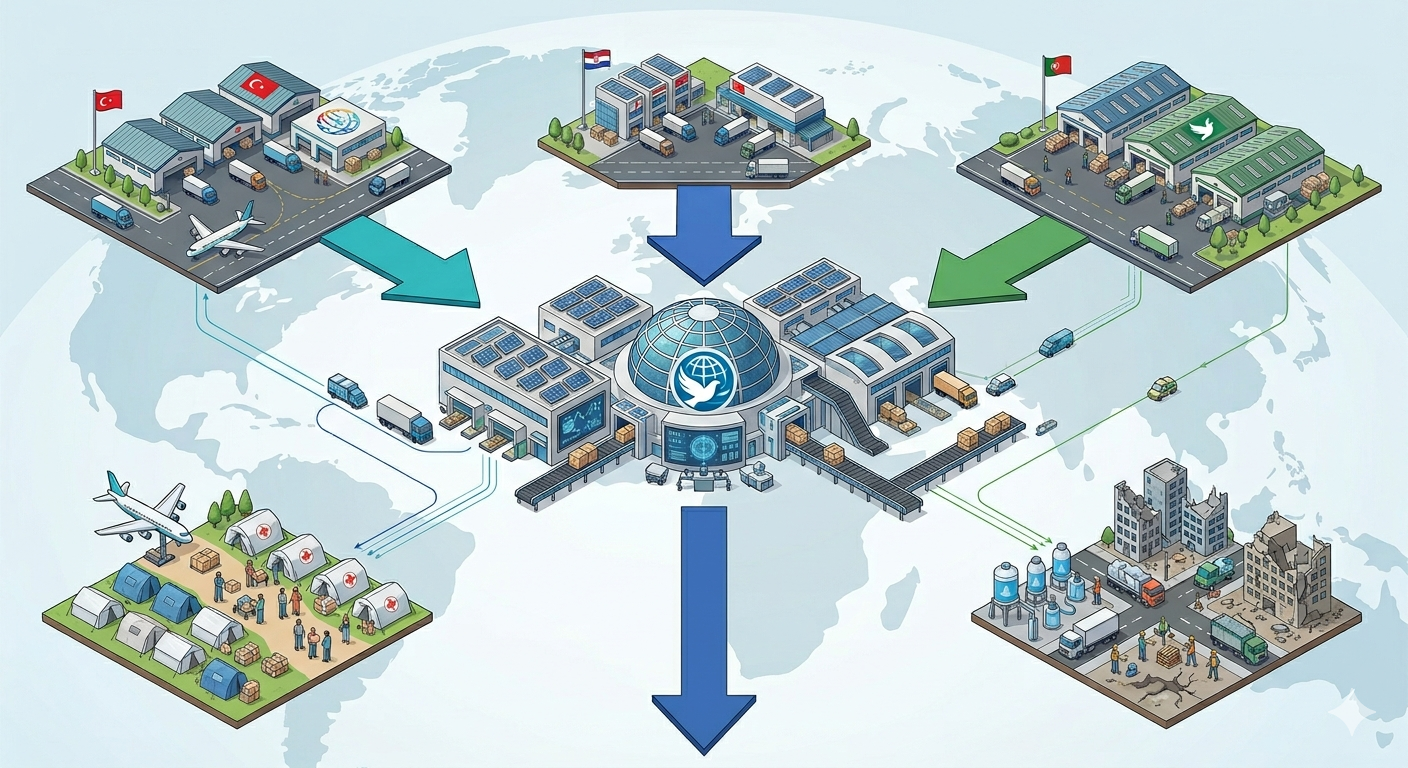
Each hub both produces and receives
Surplus production → sent to the global pool
Deficient region → supplied from the pool
Standardization Principles
Physical standard — same modular structure, same dimensions
Production standard — same seed categories, same maintenance protocols
Data standard — production/consumption is digitally reported
Distribution standard — packaging, labeling, cold chain rules
Inspection standard — international observer rotation
Quota Calculation
Country Quota = (Population × Per Capita Production Target) + Global Pool Share
Global Pool Share = Additional contribution proportional to GDP
Rich countries contribute more; weaker countries produce less and receive more
r.Strengths of the Model
Repeatable — the same blueprint is applied everywhere
Scalable — small country establishes a small hub, large country establishes a large hub
Independent — each hub produces its own energy, it is not dependent on external sources
Fair — contribution is determined by capacity, distribution is determined by need
Transparent — all data is digital and auditable
Final Word
Hunger is not destiny.
Hunger is a solvable problem.
And most importantly, hunger is not a choice; but ignoring it is a choice.
A small change you make today
can touch a person's life tomorrow.
Remember:
The world is big enough for everyone…